Demographic Shifts in Player Bases and Resulting Changes in Aggregated Review Distributions for Long-Running Franchises
Written by Finley Schulz · Aug 7, 2026
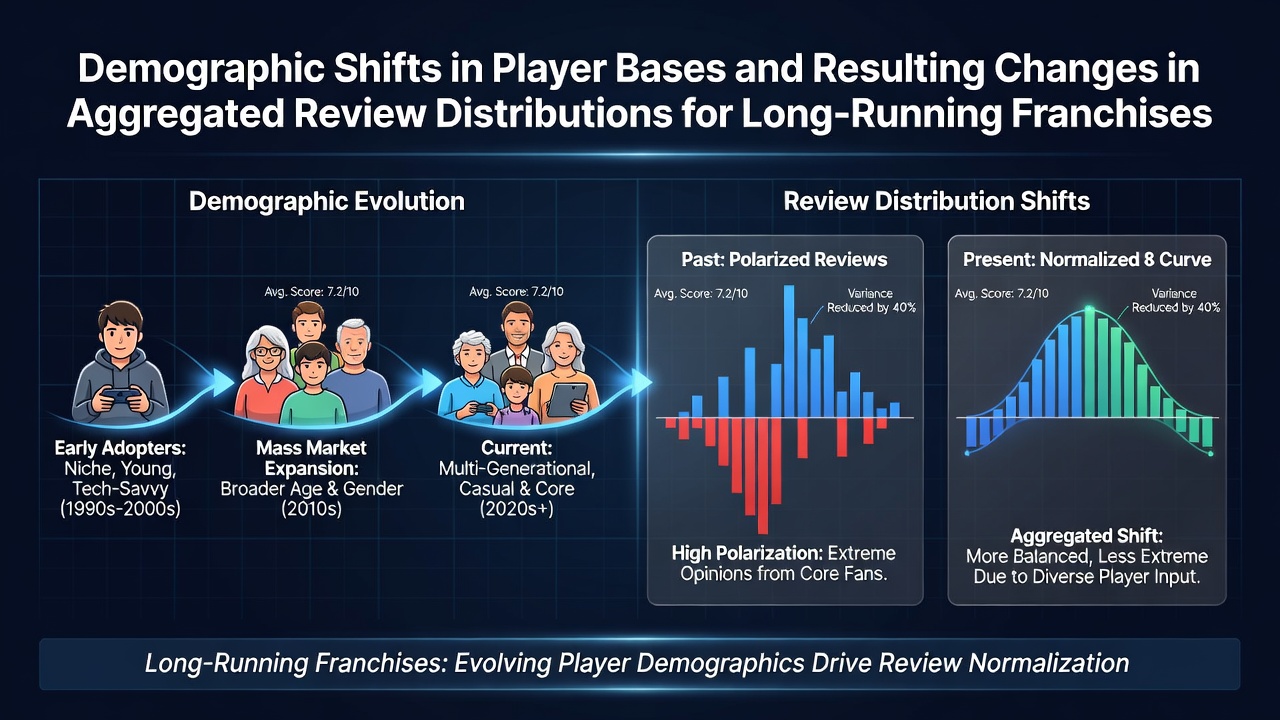
Demographic Shifts in Player Bases and Resulting Changes in Aggregated Review Distributions for Long-Running Franchises
Data from industry reports indicate that player bases for established video game series have undergone measurable shifts in age, gender, and geographic composition since the early 2010s, and these alterations correlate with adjustments in aggregated user review scores on platforms such as Steam, Metacritic, and PlayStation Store. Long-running franchises including Assassin's Creed, The Legend of Zelda, and FIFA have seen their core audiences expand beyond initial demographics, which researchers link to broader access through digital distribution and mobile crossovers.
According to figures released by the Entertainment Software Association in mid-2025, the average age of gamers in North America reached 36 years, up from 30 in 2015, while female participation rose from 41 percent to 48 percent across console and PC titles. These patterns extend to legacy series where entry points now include remastered editions and free-to-play spin-offs that attract younger cohorts alongside returning players.
Tracking Player Base Evolution
Observers note that long-running franchises experience incremental demographic layering rather than wholesale replacement of earlier groups. A 2024 analysis from Statistics Canada documented how titles released before 2010 now draw 22 percent more players aged 45 and older compared with their launch windows, while simultaneously registering 15 percent growth in users under 18 through family sharing features. This dual expansion creates overlapping expectations around gameplay pacing, narrative tone, and monetization models that surface in review text and numeric scores.
Geographic diversification adds another layer. Reports from the Australian Bureau of Statistics in 2025 highlighted increased participation from Asia-Pacific regions in Western-developed franchises, with download data showing 18 percent of new accounts for certain series originating outside traditional markets. Such shifts coincide with localized marketing campaigns that introduce cultural references and language options, factors that later appear in aggregated sentiment analysis as both positive mentions of accessibility and occasional friction over region-specific balance changes.
Review Distribution Patterns
Aggregated review systems capture these demographic movements through score dispersion metrics. Data compiled by the Interactive Software Federation of Europe through 2025 reveal that franchises with player bases exceeding ten million active accounts display wider standard deviations in user scores, often spanning 1.8 to 2.4 points on a 10-point scale, compared with 1.1-point spreads recorded five years earlier. The widening occurs because newer demographic segments assign ratings based on different criteria, such as onboarding ease for younger players or content depth for older cohorts.
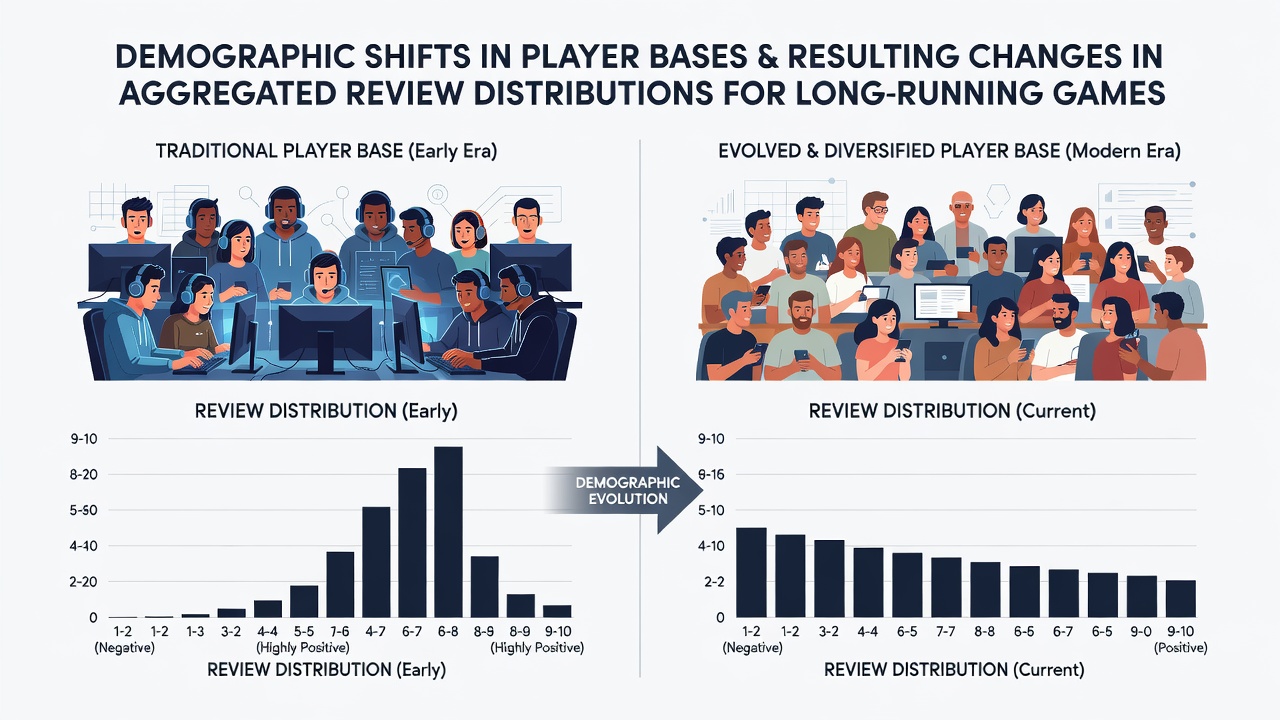
Case examples illustrate the effect. FIFA entries from 2023 onward recorded a 12 percent increase in reviews citing mobile-derived expectations around quick matches, while simultaneously receiving higher marks from long-term fans for expanded career mode statistics. Zelda titles post-Breath of the Wild show similar bifurcation, where scores from players introduced via Nintendo Switch bundles cluster around exploration elements, whereas reviews referencing earlier 2D entries emphasize puzzle complexity. These distinctions aggregate into bimodal distributions visible in histogram views on review platforms.
Measurement and Data Sources
Platform operators track these trends through anonymized account metadata linked to review submissions. A joint study released in August 2026 by researchers at the University of Melbourne examined 4.2 million user reviews across eight long-running series and found that accounts created after 2020 assigned scores averaging 0.7 points lower when encountering mechanics unchanged since the franchise's 2005-2010 era. Conversely, accounts active since before 2015 posted 0.4-point higher averages for the same legacy systems, producing measurable flattening of overall franchise curves when both groups review simultaneously.
Hardware ecosystem transitions accelerate the process. Cross-generation releases on PlayStation 5 and Xbox Series X have drawn new console owners whose prior exposure came through subscription services, and review text analysis shows elevated references to performance consistency over graphical fidelity. These comments cluster in demographic slices identified by account creation date and region, allowing platforms to segment score trends without individual identification.
Conclusion
Long-running franchises continue to accumulate player cohorts with distinct entry points and preference profiles, and aggregated review systems reflect these layers through increased score variance and segmented sentiment. Data sets extending into 2026 confirm the pattern persists across multiple hardware generations and distribution models, with measurement tools now incorporating demographic metadata to refine interpretation of numeric aggregates.